
This article originate from my contributions to Energiris, a Belgian citizens’ cooperative committed to accelerating the energy transition. As part of our mission to inform and raise awareness among both co-owners and the general public, we regularly publish educational content on topics related to sustainable energy.
The original article was published in French and Dutch, reflecting the multilingual context of our cooperative. By sharing them here in English, I also wish to reflect my personal commitment to a more sustainable and better-informed society.
Originally published on the Energiris website – 8 April 2025
The electricity market in Belgium is evolving rapidly, and with it, new tariff offers are emerging. Among these, dynamic tariff contracts stand out for their ability to adjust prices in real time according to supply and demand.
This pricing innovation, which is gaining popularity in Belgium, as you may have read in the press, is generating as much interest as it is questions. This article aims to explain exactly what dynamic pricing is: its advantages, challenges and implications.
What is dynamic pricing?
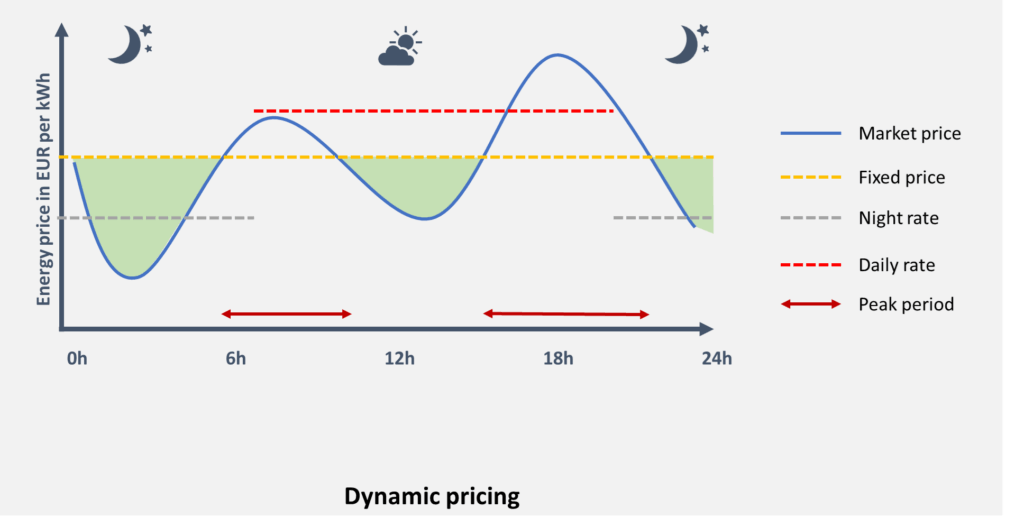
Dynamic pricing is a pricing formula where the price of electricity varies hourly based on prices on the Belgian electricity exchange. Unlike fixed or variable price contracts, dynamic pricing directly reflects fluctuations in the electricity market in real time. These contracts are only available to households and SMEs with a digital meter, making it easier to monitor and adjust their consumption.
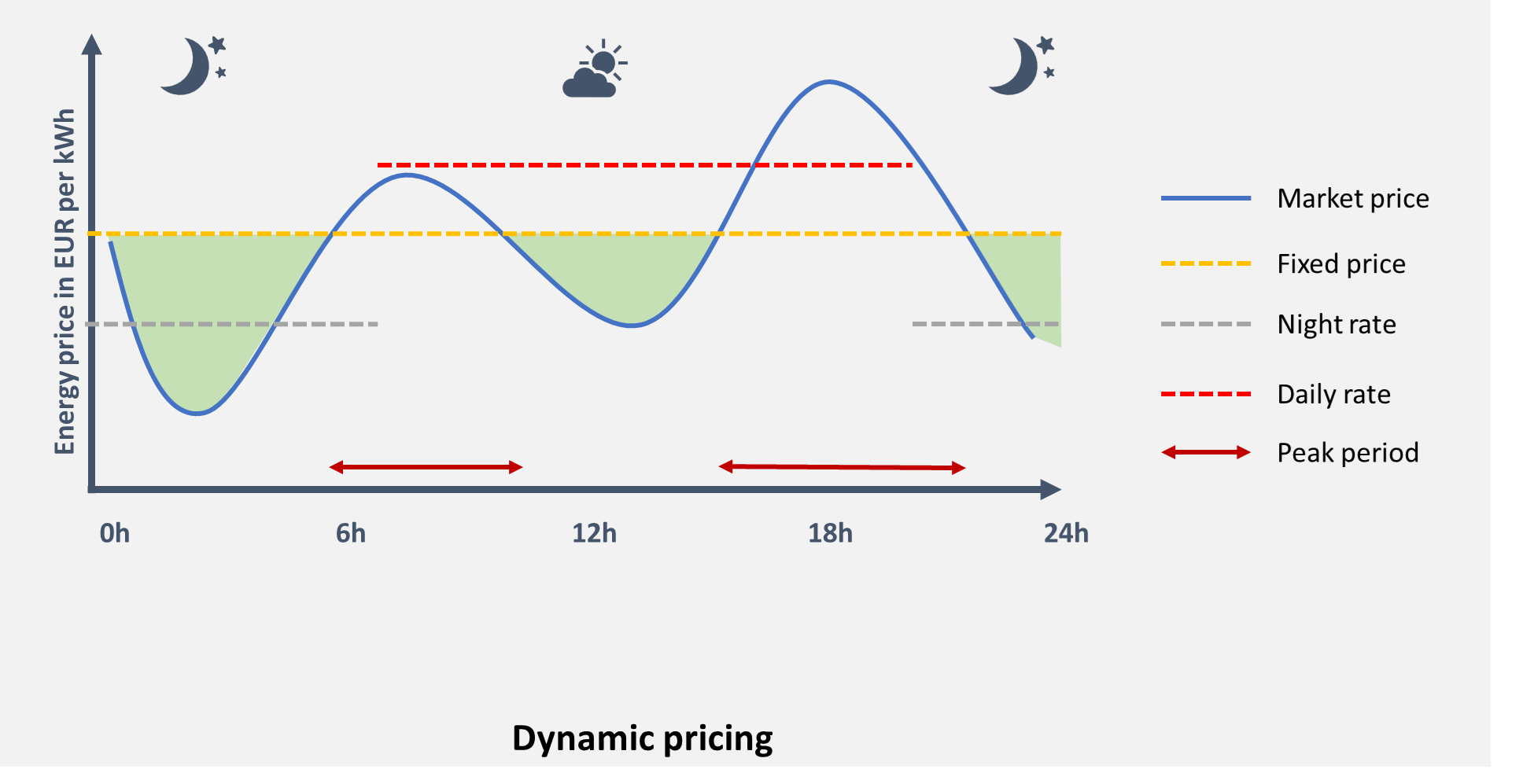
The periods when rates are most advantageous are mainly during the week, particularly between 1 p.m. and 5 p.m. and between midnight and 6 a.m.
In its March 2025 article (Sury, 2025), L’Echo reports that in September 2024, according to the CREG, the median price of electricity was only 4.24 pence/kWh at 2pm, while at 7pm it was around 9.97 pence/kWh, more than double.
Advantages of Dynamic Pricing
Dynamic pricing offers a number of advantages that make it an attractive solution in the energy sector. It allows consumers to make significant savings by adjusting their consumption to periods when prices are lowest, while promoting more responsible energy use. These contracts also encourage the use of renewable energies by incentivising higher consumption during peaks in solar or wind power production. By reducing peaks in demand, they limit dependence on polluting energy sources, as these are often used to meet such peaks.
Consumers are therefore becoming more involved in energy transition issues by controlling their energy consumption in real time, as they have an economic incentive to use energy-intensive appliances during periods of high renewable energy production.
In addition, dynamic tariffs encourage technological innovation and competitiveness:
- Competition between energy suppliers will push them to offer more attractive dynamic tariffs, refine their pricing models and design solutions that are better suited to consumer expectations.
- By seeking to stand out in the market and attract customers keen to reduce their energy bills, this intensified competition could lead to an overall improvement in services and lower prices for consumers.
- To effectively manage dynamic pricing contracts, suppliers and service companies will be encouraged to invest in research and development to find ways to better manage energy demand and maximise energy efficiency. This may lead to significant advances in renewable energy, energy storage technologies and consumption management.
- We are already seeing the first signs of this, particularly with the development of smart meters and new energy management solutions.
- This flexibility makes it possible to better meet consumer needs and support the energy transition.
Disadvantages of Dynamic Pricing
However, these contracts pose certain challenges, including increased complexity in their management. They require regular monitoring of prices in real time and adjustments in consumption habits, which can be restrictive for some users.
For those who are unable to adapt their consumption behaviour (for example, if they cannot plan the use of energy-intensive appliances during off-peak hours), dynamic pricing contracts can lead to overconsumption during peak hours and, as a result, higher bills or surcharges during peak hours, thereby increasing pressure on energy resources, which can undermine the initial objectives of dynamic pricing.
Thus, although they offer many benefits, dynamic tariffs require careful awareness-raising and appropriate tools to manage large amounts of data on energy consumption and prices to ensure effective analysis and informed decision-making in order to maximise the benefits and minimise the drawbacks.
Where can you benefit from it?
Dynamic pricing is mainly available in Flanders, but also in Wallonia for consumers dependent on RESA, the distribution network operator active in the province of Liège. DSO’s in other regions will follow in June (ORES and Sibelga) and will activate the metering system that allows for quarter-hourly measurement (called SMR3).
To benefit from this type of contract, it is necessary to have a digital meter and certain specific conditions must be met, such as annual consumption of more than 5,000 kWh. This is particularly the case for households that are not equipped with photovoltaic (PV) panels and have energy-intensive equipment, such as a heat pump, water heater or electric car charging station. By programming these appliances to operate during periods when rates are lowest, these users can significantly reduce their energy costs while optimising their consumption. (Suly, 2025).
International Examples and Local Impacts
Around the world, some countries have successfully adopted dynamic pricing:
- Denmark: Denmark has widely adopted dynamic pricing contracts, allowing consumers to benefit from lower prices during periods of high wind energy production.
- Germany: In Germany, dynamic pricing contracts are used to encourage electricity consumption during periods of high solar production, thereby contributing to better integration of renewable energies.
- United States: Some US states, such as California, have implemented dynamic tariffs to manage electricity demand and encourage the use of renewable energy.
Conclusion
Dynamic tariff contracts offer a unique opportunity to become an active and responsible consumer. While this approach requires careful management and adaptation of consumption habits to avoid bill increases and overconsumption during peak hours, it is a step towards a greener and fairer energy transition
. Adopting a dynamic tariff contract means choosing to become a more responsible and active consumer, thereby contributing to a more sustainable energy transition. Every consumer should therefore explore these opportunities.
Together, let’s choose responsible energy!
Beyond my role at Energiris, I place great importance on sharing knowledge. I have always considered education to be an essential tool for helping everyone better understand energy issues and the concrete solutions available to us. Sharing what I discover and making complex topics accessible to others is also my way of contributing to a fairer, more inclusive transition.
References consulted in writing this article
- Statbel. (2023). Energy statistics by economic sector and energy source. https://statbel.fgov.be/fr/themes/energie/statistiques-de-lenergie-par-secteur-economique-et-par-source-denergie
- FPS Economy. (2025). Belgian Energy Data Overview. https://economie.fgov.be/fr/themes/energie/lenergie-en-chiffres/belgian-energy-data-overview
- Danish Energy Agency. (2023). Energy Statistics 2023. https://ens.dk/en/our-services/statistics-data-key-figures-and-energy-maps/annual-energy-statistics
- Bundesnetzagentur. (2024). Monitoring Report 2024. https://www.bundesnetzagentur.de/EN/Areas/Energy/Companies/Monitoring/Monitoring_node.html
- California Public Utilities Commission. (2024). Dynamic Pricing Programmes. https://www.cpuc.ca.gov/industries-and-topics/electrical-energy/electric-rates/dynamic-pricing
- CREG. (2021). Dynamic pricing contracts: electricity contracts for dynamic consumers.
- CREG. (2025). Dynamic electricity pricing contracts. https://www.creg.be/fr/contrat-a-prix-dynamique-de-lelectricite
- (2025). Electricity in Belgium: dynamic pricing contracts are coming, but how do they work? https://www.rtl.be/actu/belgique/economie/electricite-en-belgique-les-contrats-tarif-dynamique-arrivent-mais-comment/2025-04-01/article/744567
- MSN. (2025). Electricity in Belgium: dynamic pricing contracts are coming, but how do they work? https://www.msn.com/fr-be/actualite/other/%C3%A9lectricit%C3%A9-en-belgique-les-contrats-%C3%A0-tarif-dynamique-arrivent-mais-comment-fonctionnent-ils/ar-AA1C4mwN?ocid=BingNewsSerp
- Dynamic pricing contracts: electricity contracts for dynamic consumers. (n.d.). CREG: Commission for the Regulation of Electricity and Gas. https://www.creg.be/fr/actualites/les-contrats-a-prix-dynamique-des-contrats-delectricite-pour-des-consommateurs
- Sury, C. (2025, 30 March). Is it in your interest to sign up for a dynamic pricing electricity contract? L’Echo. https://www.lecho.be/monargent/analyse/energie/avez-vous-interet-a-souscrire-un-contrat-d-electricite-a-prix-dynamique/10600048.html