
This article originate from my contributions to Energiris, a Belgian citizens’ cooperative committed to accelerating the energy transition. As part of our mission to inform and raise awareness among both co-owners and the general public, we regularly publish educational content on topics related to sustainable energy.
The original article was published in French and Dutch, reflecting the multilingual context of our cooperative. By sharing them here in English, I also wish to reflect my personal commitment to a more sustainable and better-informed society.
Originally published on the Energiris website – 18 March 2025
From 17 April 2025, plug & play solar panels will be officially authorised in Belgium. This new regulation marks an important step in the democratisation of solar energy. But what are these panels, how do they differ from traditional installations, what advantages do they offer to individuals, what obligations must be met, and what are their disadvantages, environmental impact and long-term effects? Let’s find out together how this innovation could transform access to solar energy.
What is a plug-and-play solar panel?
Plug-and-play solar panels represent a significant advance in the field of solar energy. They are ready-to-use photovoltaic systems designed to be quick and easy to install and use. Unlike traditional installations, these panels can be plugged directly into a standard electrical outlet thanks to a built-in micro-inverter. They are often sold in kits containing one or two panels, making them ideal for small spaces or modest energy needs. As a result, they allow more people to enjoy the benefits of solar energy without the constraints of traditional installations.
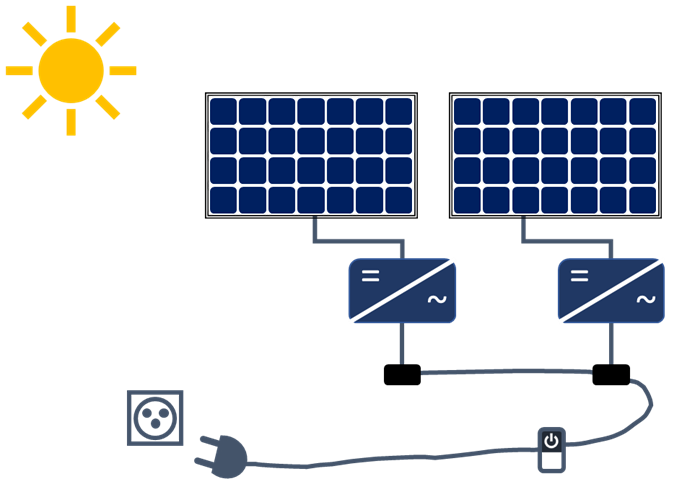
Typically, they consist of:
- Solar panels: Capture solar energy.
- Micro-inverter: Converts the direct current produced into alternating current that can be used by domestic appliances.
- Cables and plugs: Allow the system to be plugged directly into a standard electrical outlet.
Operation is simple: just place the solar panel in a sunny location, plug it into an electrical socket, and you’re done. The integrated micro-inverter converts solar energy into usable electricity, which is then fed directly into the domestic electrical grid.
Compared to traditional solar installations, these panels have several distinctive features. In particular, they are notable for their low cost, ease of installation and flexibility. Unlike conventional systems, they do not require professional installation, complex work or special connection to the electrical panel, reducing the cost of installation. In just a few minutes, they can be mounted on a balcony, in a garden or even on a façade. What’s more, their light weight and portability make them an ideal solution for tenants or people who may be moving house. However, in Belgium, their power is limited to 800 watts per connection, which restricts their ability to meet higher energy needs.
Advantages for private individuals
These panels offer many advantages for private individuals. They are an accessible solution, especially for those who do not have large spaces or who cannot install a traditional structure, such as tenants. By providing part of the energy needed to power domestic appliances, they help to reduce electricity bills and actively contribute to the energy transition and the reduction of CO2 emissions by decreasing dependence on fossil fuels.
To get the most out of these panels, a few simple tips can make all the difference. For example, it is recommended that they be oriented towards the south with an ideal angle of 30 to 45 degrees, and that any obstructions such as shadows caused by trees or buildings be avoided.
One of the main advantages of plug-and-play solar panels is their ease of installation. Here are the steps to install these panels:
- Choose the location: Place the panel in a sunny spot, ideally facing south to maximise sun exposure, with an ideal angle of between 30 and 45 degrees, ensuring that the panels are not shaded by trees, buildings or other obstacles.
- Connect the panel: Connect the panel to a standard electrical outlet using the cables provided. Take care to ensure electrical safety during this step (see below).
- Secure the installation: Ensure that the panel is securely fastened and that there is no risk of it falling or being damaged by bad weather.
Disadvantages of plug & play solar panels
Despite their many advantages, plug & play solar panels have certain limitations that need to be taken into account.
Their power is limited to 800 watts in Flanders, a reasonable limit that also applies elsewhere as it restricts the current to 3.5 amps. This limit is compatible with a standard electrical installation, but this limited capacity is only sufficient to cover a small part of a household’s energy needs. As a result, these panels are more of a backup solution than a complete alternative to traditional installations.
Their efficiency also depends on location and sunlight; installation in a shaded or north-facing area can drastically reduce their output, so care must be taken, as already mentioned, when installing them.
Furthermore, these systems require independent maintenance, and the warranties offered by manufacturers are often limited compared to those for conventional installations.
In Belgium, they do not, in principle, qualify for state aid or premiums for the resale of electricity, which is a constraint for some users. Finally, due to their low capacity, their impact on electricity bills remains relatively modest.
Environmental impact and long-term effects
The environmental impact of plug & play solar panels differs slightly from that of traditional solar installations, although the two share some common features. These differences are mainly due to the scale, type of installation and materials used.
Due to their compact size and low power output, plug-and-play panels require fewer materials to manufacture, which can reduce their initial impact in terms of natural resource and energy consumption. However, like traditional panels, they rely on materials such as silicon, the extraction and processing of which are energy-intensive. The manufacture of a plug & play installation therefore generates an ecological footprint, but on a smaller scale than that of a conventional installation, which often involves a larger number of panels and more complex mounting structures.
Another important difference lies in their lifespan and integration into the electricity grid. Traditional installations are often better optimised to maximise long-term efficiency, which offsets their higher initial impact with greater renewable energy production over decades. Plug & play panels, although equally efficient, have limited capacity and contribute less significantly to the overall reduction of CO2 emissions. Their recycling also poses challenges similar to those of traditional systems, although in smaller quantities due to their reduced size.
Obligations and recommendations for households
The installation of plug & play solar panels is subject to certain obligations and precautions to ensure their safe use:
- Device compliance: Panels must be certified according to Belgian standards (C10/26) and bear the CE mark, guaranteeing their safety and compatibility with the electrical grid.
- Power limitation: Belgian legislation imposes a limit of 800 watts per connection. This means that a household cannot install more than two plug & play panels.
- Electrical safety: A waterproof outdoor socket or an extension cord suitable for outdoor use is essential. In addition, these devices must be equipped with an automatic shut-off system in the event of a power failure, protecting both users and technicians working on the grid.
It is also important to ensure that the electrical circuit to which the devices are connected is dedicated and can withstand high currents.
Remember to check this with your electrician before connecting this type of panel.
- Responsible use: To avoid the risk of electrical overload, it is advisable not to connect several energy-intensive appliances to the same socket. In addition, it is strongly recommended that you declare the installation to your insurance company in order to ensure adequate coverage for the risks associated with its use, in particular against any damage it may suffer, as well as property damage or injury to third parties in the event of the panels becoming detached during a storm.
- No prior inspection: Unlike conventional installations, these panels do not require a prior compliance inspection, as their mobile nature allows for flexible installation. However, it is essential to follow the manufacturer’s instructions carefully to ensure correct installation, and it is strongly recommended that you seek the advice of your electrician.
- Declaration requirement: If you live in Wallonia or Brussels, your plug & play installation must be declared to your DSO (Distribution System Operator). If necessary, the DSO will install a smart meter.
Comparison with conventional solar installations
Plug & play solar panels differ from conventional solar installations in several key ways.
In terms of cost, the former are much more affordable, with prices ranging from 500 € to 1500 €, while a traditional installation requires a much larger investment, varying between 5000 € and 12000 €.
This difference is also reflected in their power: plug & play panels have a limited power output of 800 watts, which is modest compared to the several kilowatts provided by conventional systems. This limited power naturally translates into lower efficiency: a conventional installation can produce between 3,000 and 5,000 kWh per year, while two plug & play panels only reach around 770 kWh. This corresponds to a limited fraction of the average needs of a European household.
Durability is also a major point of distinction. Conventional installations often offer more extensive warranties and integrate optimally with the electricity grid, making them more sustainable. However, studies show that plug-and-play panels are particularly suitable for small budgets or occasional needs. On the other hand, traditional systems remain more cost-effective in the long term, particularly thanks to their ability to significantly meet a household’s energy needs.
Conclusion
Plug-and-play solar panels represent a significant step forward in democratising access to solar energy. Although they do not match traditional installations in terms of performance, they offer a practical, economical and environmentally friendly alternative, ideal for individuals wishing to contribute to the energy transition.
However, in order to make an informed choice, it is essential to consider their limitations, disadvantages and environmental impact.
Due to their small size, these panels have a more modest environmental impact, but their energy production remains limited over their entire life cycle, which generally ranges from 25 to 30 years. As such, their use is more of a complementary solution in the energy transition, while traditional systems, which are more powerful and durable, are better suited to meeting energy needs on a larger scale.
Beyond my role at Energiris, I place great importance on sharing knowledge. I have always considered education to be an essential tool for helping everyone better understand energy issues and the concrete solutions available to us. Sharing what I discover and making complex topics accessible to others is also my way of contributing to a fairer, more inclusive transition.
References
- Flemish Energy and Climate Agency (VEKA). (2025). Regulations for solar installations in Flanders. Retrieved from https://www.veka.be
- be. (2025). Plug & play solar panels authorised in less than a month. L’Écho. Retrieved from https://www.lecho.be
- Editorial team, E. (2025, 9 January). Plug & play or fixed solar panels? Which to choose? Mon Choix Solaire. https://www.monchoixsolaire.fr/panneaux-solaires-plug-play-ou-fixes-que-choisir-1252/
- EDF ENR. (n.d.). Solar guide: Plug and play solar panels. Retrieved from https://www.edfenr.com/guide-solaire/panneau-solaire-plug-and-play/
- Mon Kit Solaire. (n.d.). Best plug-and-play solar kit. Retrieved from https://www.monkitsolaire.fr/blog/meilleur-kit-solaire-plug-and-play-n407
- Bobex. (n.d.). Tax benefits for solar panels. Retrieved from https://www.bobex.be/fr-be/panneaux-solaires/installation/avantages/fiscal/
- Synergrid. (2023). From 17/04/2025, plug-and-play devices will be able to be connected in Belgium. Retrieved from https://www.synergrid.be/fr/news-centre/press-room/a-partir-du-17-04-2025-les-appareils-plug-play-pourront-etre-raccordes-en-belgique
- Energy Revolution. (2023). Plug-and-play solar panels and batteries finally authorised in Belgium. Retrieved from https://www.revolution-energetique.com/les-panneaux-solaires-et-batteries-pretes-a-brancher-enfin-autorisees-en-belgique/
- Azaneo. (n.d.). Plug-and-play solar kit for beginners: Where to start? Retrieved from https://azaneo.com/kit-solaire-plug-and-play-debutants-par-ou-commencer/
- Energreen. (n.d.). Photovoltaic panels. Retrieved from https://www.energreen.be/nl/fotovoltaisch/fotovoltaische-panelen
- Kelwatt. (n.d.). How plug-and-play solar panels work. Retrieved from https://www.kelwatt.fr/guide/panneaux-solaires/fonctionnement-plug-and-play
- Mon Panneau Solaire. (n.d.). Plug-and-play panel reviews: profitability, testimonials. Retrieved from https://mon-panneau-solaire.info/autoconsommation/kit-plug-and-play-avis/