
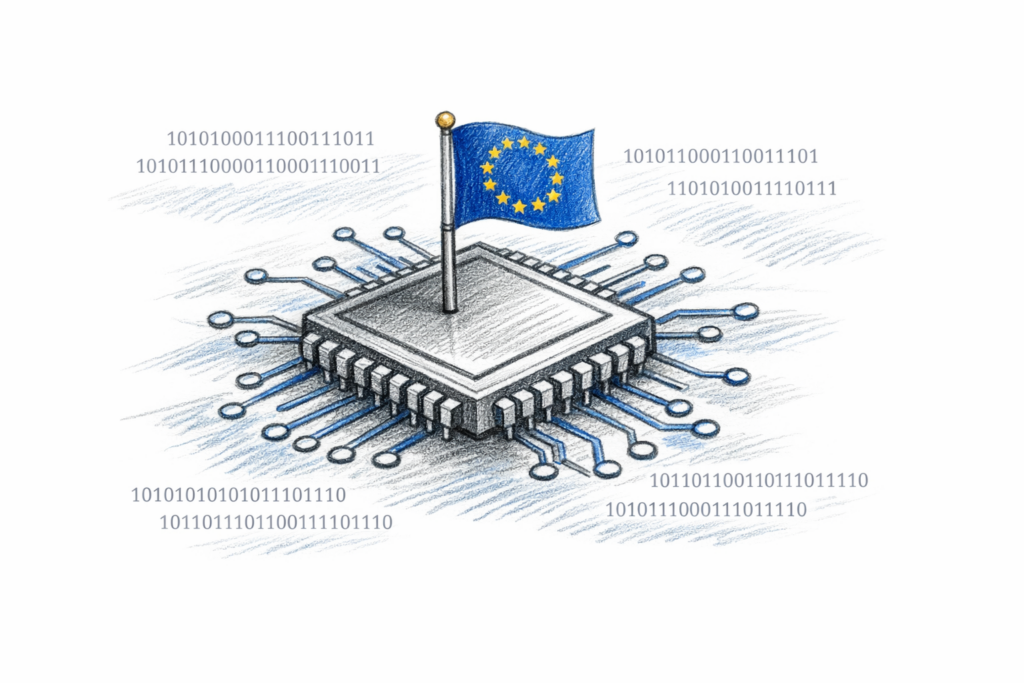
When a tiny component reveals a systemic vulnerability
It took just a few hard-to-find chips, in the wake of Covid, for Europe to realise just how much its manufacturing sector relied on a fragile and largely outsourced technological infrastructure. In the automotive, electronics, medical equipment and telecommunications sectors, the absence of a component – sometimes a seemingly trivial one – was enough to bring entire production lines to a standstill. The white paper I read recently highlights this with almost brutal precision: “the absence of a single component is enough to halt assembly”. This seemingly innocuous sentence actually says something profound about our collective dependence on a technology that has become invisible through sheer ubiquity.
Of course, this shortage was not solely the result of a lack of industrial capacity, but also of cyclical effects specific to the highly capital-intensive semiconductor industry (long production lead times, rapid reallocation of capacity towards consumer electronics, and the fragility of just-in-time models).
Over the past few months, I have taken the time to explore in depth several analyses devoted to the European Chips Act, including this particularly comprehensive white paper published by Techniques de l’Ingénieur. It brings together interviews with key players in the sector, technological analyses and industrial perspectives that shed light on the European strategy from a practical angle. Drawing on these various publications, as well as official sources from the European Commission and the Belgian microelectronics ecosystem, I offer here a personal and strategic interpretation of what the Chips Act truly represents for our technological sovereignty.
I remember that period when we discovered, almost in disbelief, that European car factories were unable to deliver vehicles for a reason as trivial as a missing microcontroller. It was not just a logistical crisis: it was a wake-up call. A mirror held up to Europe, showing it just how much it had let strategic industrial control slip away. For decades, we relied on the fluidity of global value chains, on international specialisation, on the idea that technology would always be available, everywhere, all the time. That belief collapsed in a matter of months.
What the Covid crisis has revealed
- The absence of a single component can bring an entire industry to a standstill.
- Just-in-time supply chains are not suited to semiconductor cycles.
- Europe has discovered its structural dependence.
Europe faces a triple vulnerability
The health crisis was only the first shock. The second came from global technological rivalry. The concentration of advanced manufacturing in Asia, Sino-American tensions, export restrictions, dependence on Taiwan for the most advanced nodes… All this has turned semiconductors into a major geopolitical issue. As Jean-René Lèquepeys, deputy director of CEA-Leti, points out, “Taiwan remains a major point of vulnerability”. This dependence is not merely economic: it is strategic, systemic and civilisational. It determines our ability to innovate, produce, defend, provide healthcare and communicate.
The third shock is more insidious: Europe has discovered that it consumes a huge amount of chips, but produces very few. Or, to be more precise, Europe consumes a large quantity of advanced semiconductors whilst remaining weakly positioned in the most advanced logic nodes, despite a strong presence in the analogue, automotive and power electronics segments. This creates a structural imbalance between design capability and mastery of the most advanced processes.
The white paper highlights “a low share of production on European soil relative to consumption” (in the region of 10% to 12%). This asymmetry creates a systemic risk for the automotive sector, consumer electronics, electricity grids, telecommunications, defence and critical infrastructure.
These three shocks have revealed a structural dependency that can no longer be ignored.
Why Taiwan is a global weak point
Taiwan accounts for over 90% of global production of the most advanced logic chips (5 nm and below). TSMC, its national champion, has become a systemic player. A geopolitical crisis, a blockade, a natural disaster or a cyberattack could trigger a global economic shock. Europe, like the United States, depends on this island for its most critical technologies.
The concentration in Taiwan mainly concerns advanced logic, whilst other segments (analogue or power) remain more geographically dispersed.
As long as Europe remains dependent on Taiwan for its advanced nodes, it will remain vulnerable.
Why Taiwan is a systemic risk
- >90% of advanced chips produced on a single island.
- Extreme geopolitical vulnerability.
- Direct dependence of critical European sectors.
The Chips Act: a clear political ambition
It is against this backdrop that the European Union launched the Chips Act, which came into force in 2023, with a clear objective: to regain the ability to act on a technology that underpins innovation, industrial competitiveness and the security of critical infrastructure. The ambition is clear: to account for 20% of global semiconductor production by 2030.
The strategy is based on three pillars: funding the industrialisation of key technologies (~€43 billion), creating a favourable environment for ‘pioneer plants’ capable of mitigating process risks, and establishing coordination mechanisms to anticipate supply crises. This framework is coherent, but it raises a crucial question: will Europe be able to deliver on what it has so often been able to conceive?
I cannot help but think that the Chips Act is also a test of collective maturity. Europe excels at defining ambitious visions, but it sometimes struggles to translate them into concrete, coordinated and rapid achievements. Fragmented funding, diverse national strategies and administrative delays are all risks that could weaken the programme’s impact.
The risks of internal fragmentation
Several European industrial initiatives have encountered difficulties with implementation or coordination, particularly in the sovereign cloud or certain digital strategies, illustrating the structural challenges of industrial governance at European level. We can also cite results that remain mixed, reflecting the difficulties of industrial coordination at European level in the fields of batteries and artificial intelligence.
The Chips Act could suffer from the same problem if Member States prioritise their national champions at the expense of a common strategy. Success will depend on the ability to pool investments, harmonise state aid and avoid duplication of infrastructure.
Risks that could derail the European strategy
Beyond internal fragmentation, other broader risks weigh on Europe’s trajectory. The first is that of increased strategic dependence: if Europe does not move fast enough, it could find itself even more dependent on the United States and China, not only for advanced nodes but also for equipment, EDA software and critical supply chains. The second risk is the inability to attract or retain talent, in a sector where global competition is fierce. A third risk relates to potential delays in distributed AI and edge computing, areas in which Europe could nevertheless excel. Finally, dependence on US and Chinese supply chains could limit Europe’s strategic manoeuvre, even if it increases local production. These risks should not be discouraging: they underline the urgency of swift and coordinated action.
Europe’s strengths: a solid foundation, often underestimated
Yet Europe is not without resources. It possesses considerable strengths, which are often underestimated. Its research centres (CEA-Leti, IMEC in Belgium, Fraunhofer in Germany), functioning as pre-competitive research platforms linking manufacturers, equipment suppliers and designers, are among the best in the world. Its manufacturers (STMicroelectronics, Infineon, NXP, Bosch) dominate key segments such as power electronics. Its regional ecosystems, such as the one in Leuven centred on IMEC or the one in Grenoble centred on the CEA, are internationally recognised centres of excellence.
Belgium, in particular, plays a role disproportionate to its size. IMEC has become one of the world’s leading centres for collaborative research in microelectronics, working with industry giants from TSMC to Intel and developing cutting-edge technologies that directly influence global roadmaps. Melexis, another Belgian player, is a leader in automotive sensors, a field where demand is booming with the electrification and automation of vehicles. X-FAB, based in Wallonia, contributes to the production of analogue and power chips, which are essential for industrial and automotive applications. The DSP Valley cluster, which links companies, universities and research centres in Flanders and Wallonia, illustrates Belgium’s ability to build bridges between innovation and industry.
The semiconductor industry is not an integrated industry but a stack of specialised and interdependent ecosystems, where the final performance results from successive optimisations between design, equipment, processes and system integration.
Europe is not starting from scratch: it is building on a foundation of excellence that is all too often underestimated.
IMEC: a Belgian player at the heart of global strategy
IMEC is one of the world’s most influential R&D centres in microelectronics. Its work on neuromorphic architectures, optical interconnects, 3D technologies and advanced materials is utilised by the world’s leading manufacturers. Europe relies heavily on this expertise to structure its pilot lines and technology roadmaps.
Pilot lines: a distinctly European tool
One of the most emblematic elements of the European strategy is the creation of pre-industrial pilot lines. Europe is not seeking to replicate the Asian model of mega-fabs (where construction of advanced fabs takes 3 to 5 years, followed by several years of industrial ramp-up before reaching optimal production and stable industrial yields); Instead, it is focusing on intermediate infrastructure, designed to accelerate the transition from the laboratory to the market.
They also play a key role in co-development between designers, equipment manufacturers and foundries, enabling the validation of complete technological ecosystems prior to industrialisation.
The FAMES pilot line, inaugurated in Grenoble, is the most successful example of this. With an investment of €830 million, it covers five strategic technological building blocks: 10 and 7 nm FD-SOI, embedded non-volatile memory, 3D integration, RF components and power management circuits. Dominique Noguet, project coordinator, sums up the challenge perfectly: “FAMES is an intermediate step designed to bridge the gap.” It is neither a factory nor a laboratory, but a space where processes are stabilised, performance is qualified, integration is validated, and industrial-scale demonstrators are produced.
Pilot lines are the most European and strategic tool for reducing industrial risk. They embody the way in which Europe can transform its research into industry; provided it knows how to deploy them on a large scale.
What is the purpose of a pilot line?
- To stabilise processes.
- To reduce industrial risk.
- To accelerate the transition from lab to market.
- To share costs.
What is a pilot line?
A pilot line is a pre-industrial facility that enables processes to be tested, stabilised and validated before they move into mass production. It reduces risk, cost and time-to-market. It is accessible to SMEs, start-ups, academic institutions and large corporations, making it a tool for technological sovereignty.
Realistic technological sovereignty, not illusory self-sufficiency
This approach is deeply European. It values collaboration, sharing and openness. It enables SMEs, start-ups, academic institutions and large corporations to access state-of-the-art equipment without having to invest hundreds of millions of euros. It creates an environment where innovation can become a product, where research can become industry, where vision can become sovereignty.
But this sovereignty must not be understood as a quest for total self-sufficiency. Lèquepeys rightly points this out: “Sovereignty does not mean total self-sufficiency, but the ability to hold on to critical segments.” This nuance is essential. Europe will not be able to produce everything, master everything, or control everything. But it can and must secure the technological building blocks that underpin its strategic autonomy.
What technological sovereignty means to me
I do not see sovereignty as a retreat, but as the ability to choose. To choose what we want to master. To choose what we want to produce. To choose what we want to protect. To choose what we want to invent. Sovereignty is not a state, but a movement. Not a destination, but a trajectory.
Areas where Europe can really take the lead
One area in which Europe has structural industrial advantages that could serve as a strategic lever is edge computing.
Unlike data centres, which are dominated by general-purpose GPUs and massively parallel architectures, the edge demands compact, low-power, specialised solutions. It requires bringing memory closer to the computation, or even performing computation within the memory. It necessitates architectures capable of processing data locally, with low latency, low power consumption and high robustness. As is often the case in microelectronics, these architectures prioritise energy efficiency and low latency at the expense of raw performance. This is an area where Europe already excels, thanks to its expertise in the automotive, industrial, energy and healthcare sectors. It is also an area where Belgium plays a key role, with IMEC’s work on neuromorphic architectures, advanced memory, optical interconnects and 3D technologies.
Power electronics is another area where Europe holds a strong position. Wide-bandgap technologies (SiC, GaN, gallium oxide, diamond) enable a drastic reduction in losses in converters, chargers and inverters. They are essential for electric vehicles, smart grids and data centres. STMicroelectronics, Infineon and other European players are already leaders in these markets. Belgium is also contributing to this momentum, notably through IMEC’s work on GaN and advanced power devices.
Quantum computing on silicon represents another strategic opportunity. The CEA is working on silicon qubits that are ‘a million times smaller’ than superconducting alternatives. IMEC is also exploring hybrid approaches combining photonics, silicon and advanced materials. Europe could develop a distinctive position in this field, although the technological outcome remains open and highly competitive at present: not by seeking to build universal quantum computers, but by developing specialised coprocessors, integrated into classical architectures, for targeted applications.
Three areas where Europe can lead
- Edge computing.
- Power electronics.
- 3D integration / low-power architectures.
The memory wall: a structural challenge
Current AI relies on very powerful GPUs, but memory can no longer keep up. Moving data consumes more energy than the computation itself. This ‘memory wall’ (often referred to in the literature as the memory wall), a phenomenon linked in particular to the slowing down of memory scaling and the rising energy costs of data transfers, requires a rethink of architectures: in-memory computing, 3D integration, and memory-computing proximity. Europe is well positioned in these technologies.
Challenges to be overcome: funding, skills, implementation
However, despite these strengths, numerous challenges remain. Funding is fragmented, national strategies sometimes diverge, and skills are insufficient.
EUV lithography remains dominated by ASML, which holds a near-monopolistic position, but access to certain generations of equipment is subject to geopolitical restrictions. Global competition is fierce, with massive subsidies in the United States and China.
Unlike other manufacturing industries, the semiconductor economy relies on extreme economies of scale, where only a few global players can absorb the investment required for the most advanced technology nodes.
The skills shortage threatens execution capacity, particularly in the fields of advanced lithography, ASIC design and process engineering. Above all, Europe must avoid repeating its past mistakes: fragmentation, sluggishness and the inability to turn a vision into reality.
Europe and its industrial contradictions
I am struck by this constant tension between ambition and execution. Europe is good at thinking long-term, but struggles to act quickly. It is good at defining visions, but hesitates to take decisive action. It is good at collaborating, but becomes fragmented. The Chips Act will be a test: a test of our ability to overcome our contradictions.
Conclusion: a necessary gamble, a collective responsibility
I firmly believe that the Chips Act is a necessary gamble. Not a gamble to catch up, but a gamble on transformation. Europe must not seek to imitate current leaders, but to chart its own course. A course based on energy efficiency, advanced integration, lean architectures, mastery of critical components, and the ability to industrialise more quickly. A path that capitalises on its strengths (research, engineering, the power industry, edge computing, advanced materials) rather than chasing models that do not suit it.
The white paper sums it up with remarkable clarity: the challenge is not merely to produce more, but to ‘make sovereignty a technological strategy’. This sentence, in my view, is the key to everything. It says that sovereignty is not a state, but a movement. Not a destination, but a trajectory. Not a closure, but a capacity to choose.
And perhaps this is where the crux of the matter lies: in our collective ability to choose. To choose what we want to control. To choose what we want to produce. To choose what we want to protect. To choose what we want to invent. To choose, finally, what we want to be in a world where technology is no longer merely a tool, but a condition of sovereignty.
The Chips Act is not merely an industrial plan; it is the way in which Europe chooses to exert its influence in the world in the technological age. It commits our ability to choose what we wish to control, protect and invent. It commits our sovereignty, not as a retreat, but as a collective trajectory. The question is no longer whether Europe can succeed: it is whether it will act quickly enough to turn this ambition into reality.
The Chips Act is a test. And history will judge our ability to deliver.
Bibliography
- Techniques de l’Ingénieur, The Chips Act: The European Union’s Industrial Challenge, white paper, 2026. https://www.techniques-ingenieur.fr/actualite/livre-blanc/le-chips-act-pari-industriel-de-lunion-europeenne-155763/
- European Commission, European Chips Act, 2023. https://digital-strategy.ec.europa.eu/fr/policies/european-chips-act
- CEA-Leti. (n.d.). Publications and scientific news. https://www.leti-cea.com/
- IMEC. (n.d.). Research & Publications: annual reports and scientific publications. https://www.IMEC-int.com/
- STMicroelectronics. (n.d.). Sustainability and environmental commitments: environmental commitments and strategic documents. https://www.st.com/content/st_com/en/about/st_approach_to_sustainability.html
- Sector analyses on power electronics, neuromorphic architectures and wide bandgap technologies:
- Power Electronics Europe. (n.d.). Industry insights and reports. https://www.power-mag.com/
- IEEE Spectrum. (n.d.). Neuromorphic computing and semiconductor technologies. https://spectrum.ieee.org/
- Compound Semiconductor. (n.d.). Wide bandgap materials and devices. https://www.compoundsemiconductor.net/